Photographing the Katla ice cave
The pictures on the booking pages were not taken on a gray afternoon with a dozen helmets behind you. The real cave is dimmer and wetter, with other people in it. Your time inside is short too. A little planning still brings home good shots, even on a phone. Settings and lenses come first below, then the habits that help, including when to hand your phone to the guide.
Darker than the listing photos
Set your expectations by the light you will meet, not the brochure. Gravel Travel's listing says its photos are not taken in real time and that caves change, and the same goes for every operator. Treat each listing photo as a sample of what the ice can look like on a good day. Inside, the cave is dim and the walls drip, and the color depends on the light outside and the state of the ice that week. If you are still choosing a glacier, Katla or Vatnajökull explains why the Katla ice is striped with ash rather than clear blue.
Phone or camera
A recent phone handles the cave well. Night mode stacks several frames into one brighter picture, and a phone slips into a pocket when you need both hands on the ice. A camera with a larger sensor gives cleaner pictures in low light, but you will carry it up a glacier in crampons and in and out of a wet cave. One small body with one lens beats a full bag.
Whatever you carry, fit the widest lens you own. The cave is often small and the group stands close together, so a wide view is the only way to get the ceiling and both walls into one frame. On a phone that means the ultra-wide setting, which also lets you stand nearer the ice without cutting it off.
Settings for low light
- Raise the ISO. On a camera, start around ISO 1600 to 3200 and accept some grain. A sharp grainy picture beats a clean blurred one;
- Keep the shutter fast enough. With a wide lens, around 1/30 second is usually safe handheld. Tuck your elbows against your chest and breathe out as you press;
- Open the aperture. Use the widest setting your lens allows;
- Expose for the ice. A bright entrance fools the meter into darkening everything else, or the ice washes out. Dial in a little minus exposure on a camera; on a phone, tap the ice and nudge the brightness slider down;
- Shoot raw if you can. Cave light pushes every color toward blue, and a raw file lets you fix the balance at home.
Leave the tripod at the hotel. In a group there is no room to set one up, and nobody waits while you do. Handheld shots at a high ISO work better here than any long exposure.
Headlamps and the guide's light
Katlatrack hands out headlamps along with the helmets and crampons, and on every tour the guide carries a light. A headlamp pointed straight at the ice flattens it, so for pictures switch yours off or turn your head away and let the light from the entrance do the work. If the guide's lamp shines through a thin wall from behind, the blue lifts out of the gray. Turn the flash off, because it bounces off wet ice and turns every drip into a white speck.
Headlamps and room for clean shots
Katlatrack includes a headlamp with the helmet and crampons, and reviewers say its guides gave everyone time for photos with nobody else in the frame, from ~$220. It leaves Austurvegur 16 several times a day, with groups of up to 24.
Cold lenses and dripping ice
Inside the cave it is around freezing and dripping, while outside the wind blows across the sands. Moving between the heated jeep and the damp cave makes lenses fog, and the wind on the glacier does not help. Give the camera a few minutes to settle before the first shot, and seal it in a bag before you climb back into the warm jeep, so the moisture forms on the bag rather than the glass.
- A dry cloth in an inside pocket. Drips land on the lens all the time, so wipe before every frame;
- A dry bag or a plastic bag for the phone. It keeps out meltwater between shots;
- A spare battery kept warm. Cold drains batteries fast, so carry the spare close to your body;
- Thin gloves that work a touchscreen. Bare fingers go numb quickly on the ice;
- A wrist strap. A phone dropped on a slope of ice may not stop.
Our clothing and boots guide covers the waterproof layers and boots that keep the rest of you dry.
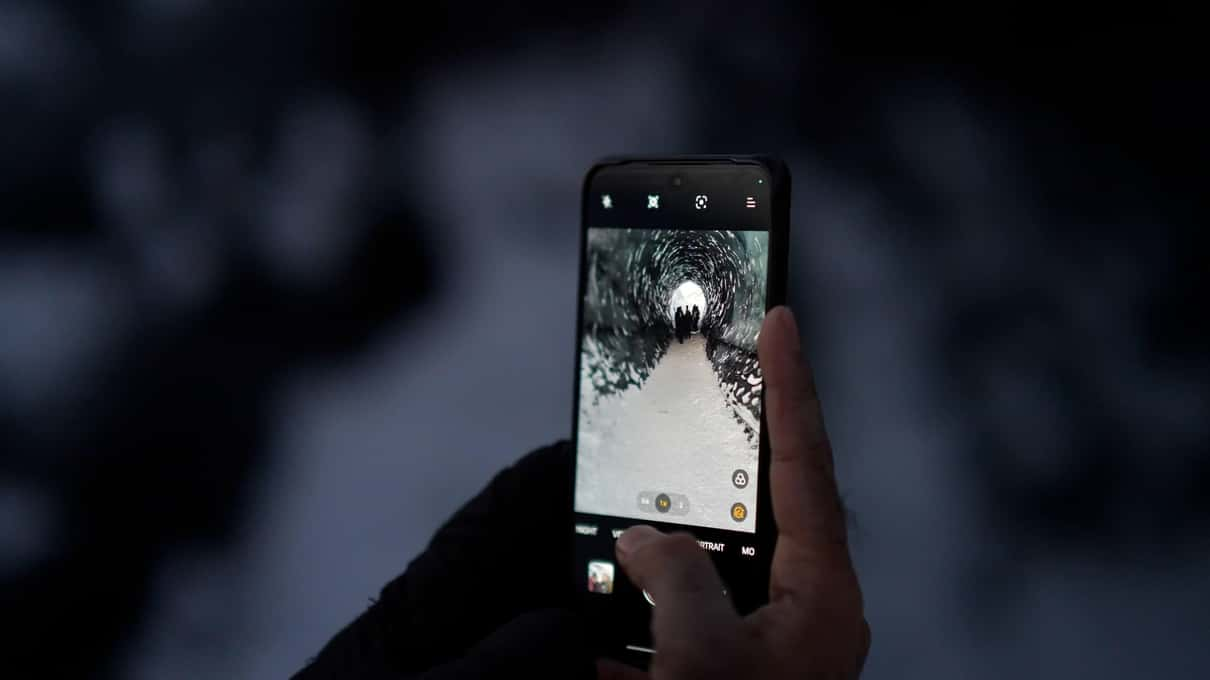
A short visit, so plan your shots
Time inside is not long. An Arctic Adventures reviewer counted 20–30 minutes around the cave, and Gravel Travel's listing gives about 30 minutes in the cave. Troll.is and Katlatrack set aside an hour-long block for the walk and the cave, safety briefing included. Decide before you go in what you want, say a wide view of the whole space, a portrait of your party, a close look at the ash bands and one frame back toward the entrance. Then put the phone away and look around. A Gravel Travel guide asks the group for a few minutes of silence without phones in the cave, and those quiet minutes deserve your attention more than another frame.
Let the guide take the picture
Guides on these tours take photos for guests all the time, and many reviews praise them for it, Syra and Otto among them. Hand over your phone with the wide setting ready and step into the light. Katlatrack reviewers add that their guide made sure everyone got shots without strangers in the background. Tipping is not expected in Iceland, but a guide who spent the visit framing your pictures would appreciate it. Drones are out, since Katlatrack's listing does not allow them, and a cave full of people in crampons is no place to fly one.
Pictures on the way there
Some of the best frames come from outside the cave. Gravel Travel reviewers mention photo stops on the drive, and Troll.is reviewers describe a viewpoint stop before the glacier, and its listing promises views of Hafursey. Bring sunglasses for bright snow, and save some battery for the black ash at the foot of the ice. Katla volcano and the Mýrdalsjökull glacier explains the landscape you are photographing.
Photographers who want more time on the glacier can look at the extended 4-hour Troll.is tour, from ~$292, which adds a longer hike with glacier canyons and hidden waterfalls for up to 14 people. Its catch is the thin record, with very few reviews so far. Coming from the capital, Gravel Travel's 10-hour day from Reykjavík, from ~$268, packs in Seljalandsfoss (with a walk behind it, weather permitting) and the Víkurfjara black beach, but the catch is about 30 minutes in the cave itself. Light changes a lot between winter and summer, which the best time for the Katla ice cave covers, and how hard the walk is helps you judge how much gear to carry.